
Can AI Remove Watermarks? How to Protect Product Photos
Yes, AI can erase many watermarks. See what research shows, what makes product-photo watermarks harder to strip, and the other defenses stores need.
10 min readUpdated Oct 9, 2026
Can AI remove watermarks from photos?
Yes. Today's AI image editors can erase many visible watermarks from a single photo and fill in the gap, and researchers have shown that a watermark repeated identically across many images can be estimated and stripped automatically, so no watermark is unremovable. What you can control is the cost of removing it: marks that cross product detail, cover more of the image, vary from photo to photo, and are backed by stored originals and fast takedowns make your photos a worse target.
If that worries you, you're not alone. Photographers have described exactly this problem, for example in an r/photography thread about clients using AI to remove watermarks.
This guide is written for store owners who protect their product photos, not for anyone trying to strip someone else's mark, so it contains no removal instructions. It's an honest look at what AI watermark removal can do today, what makes a watermark harder to remove, and the other defenses that matter as much as the mark itself.
Yes, AI can remove many watermarks. Here's how.
Single-image inpainting: the common case
General-purpose AI image editors and dedicated watermark removers work in a similar way: they erase the mark and invent the pixels that were underneath. In March 2025, reporters found Google's experimental Gemini 2.0 Flash image model removing watermarks, including Getty Images marks. A Google spokesperson told TechCrunch that using its generative AI tools to infringe copyright violates its terms of service.
Reporting: TechCrunch, March 17, 2025.
Also covered by The Verge, which notes that dedicated AI watermark removal tools already exist. We don't link to them.
The output isn't your original photo. Ars Technica found the result was “nowhere near the resolution or detail quality of the original,” because the model “fills in the watermark space with the most plausible result based on its training data.” In other words, the AI guesses.
Collection attacks: when every image carries the same mark
Google researchers showed in 2017 that when the same watermark appears the same way across many images, an algorithm can estimate it and recover the originals with high accuracy. That attack doesn't need an AI editor at all. It exploits repetition, which is exactly what a catalog with one fixed logo in the same corner provides.
The paper also notes a weakness of the attack: removal inaccuracies “show up as visible artifacts when the underlying image is smooth.”
Source: Dekel, Rubinstein, Liu and Freeman, “On the Effectiveness of Visible Watermarks,” CVPR 2017.
Plain-language summary: Google Research, Making visible watermarks more effective.
Invisible watermarks aren't a fix either
Invisible watermarks hide a signal in the pixels instead of drawing a visible mark. Researchers proved that pixel-level invisible watermarks can be removed with regeneration attacks, which pass the image through a generative model. The paper covers pixel-level schemes and suggests semantic watermarks as an alternative, so it isn't the last word on every invisible method. RD Watermark doesn't offer invisible watermarking or C2PA content credentials.
Source: Zhao et al., “Invisible Image Watermarks Are Provably Removable Using Generative AI,” NeurIPS 2024.
| What the research and reporting say | Source |
|---|---|
| A watermark repeated the same way across many images can be estimated and removed automatically. | Dekel et al., CVPR 2017 |
| Random position changes and small opacity changes alone did not stop that attack; per-image warping improved robustness. | Google Research blog, 2017 |
| An experimental AI image model removed watermarks, including Getty Images marks. | TechCrunch and The Verge, 2025 |
| The same model appeared to struggle with some semi-transparent marks and marks covering large areas. | TechCrunch, 2025 (reported, not a test) |
| Pixel-level invisible watermarks can be removed with regeneration attacks. | Zhao et al., NeurIPS 2024 |
So are watermarks pointless? No. They change the economics.
Protection here means raising the effort and leaving attribution, not perfect prevention. A visible watermark doesn't lock a photo. It makes reusing that photo slower, riskier, or worse-looking.
Removal has a cost. A removed watermark can leave artifacts and lose detail, as the reporting and the 2017 paper describe. On a product photo, that can mean invented stitching, texture, or label detail, which is a real problem for anyone trying to sell with your images.
A lot of image theft is lazy and done in bulk: scraped catalogs and copied product pages. In our judgment, a visible mark makes your images a less attractive target for that kind of copying than an unmarked competitor's. That's an opinion based on how merchants describe the problem, not a measured result.
What makes a watermark harder to remove
Cross the product, not the empty corner
A mark over textured product detail forces an AI editor to guess what's underneath, and the guess is “the most plausible result,” not your product. A mark in an empty corner can simply be cropped off. The trade-off is that a mark across the product is more intrusive, so use it on your most-copied images rather than on every photo.
For settings that stay readable without hiding the product, see watermark size, placement and opacity.
Cover more of the image with a semi-transparent or tiled pattern
In March 2025, TechCrunch reported that Gemini 2.0 Flash “appears to struggle with certain semi-transparent watermarks and watermarks that canvas large portions of images.” That was an observation at the time, not a controlled test, and AI models keep improving. Treat it as a reason to consider a tiled pattern on high-risk images, not as a guarantee.
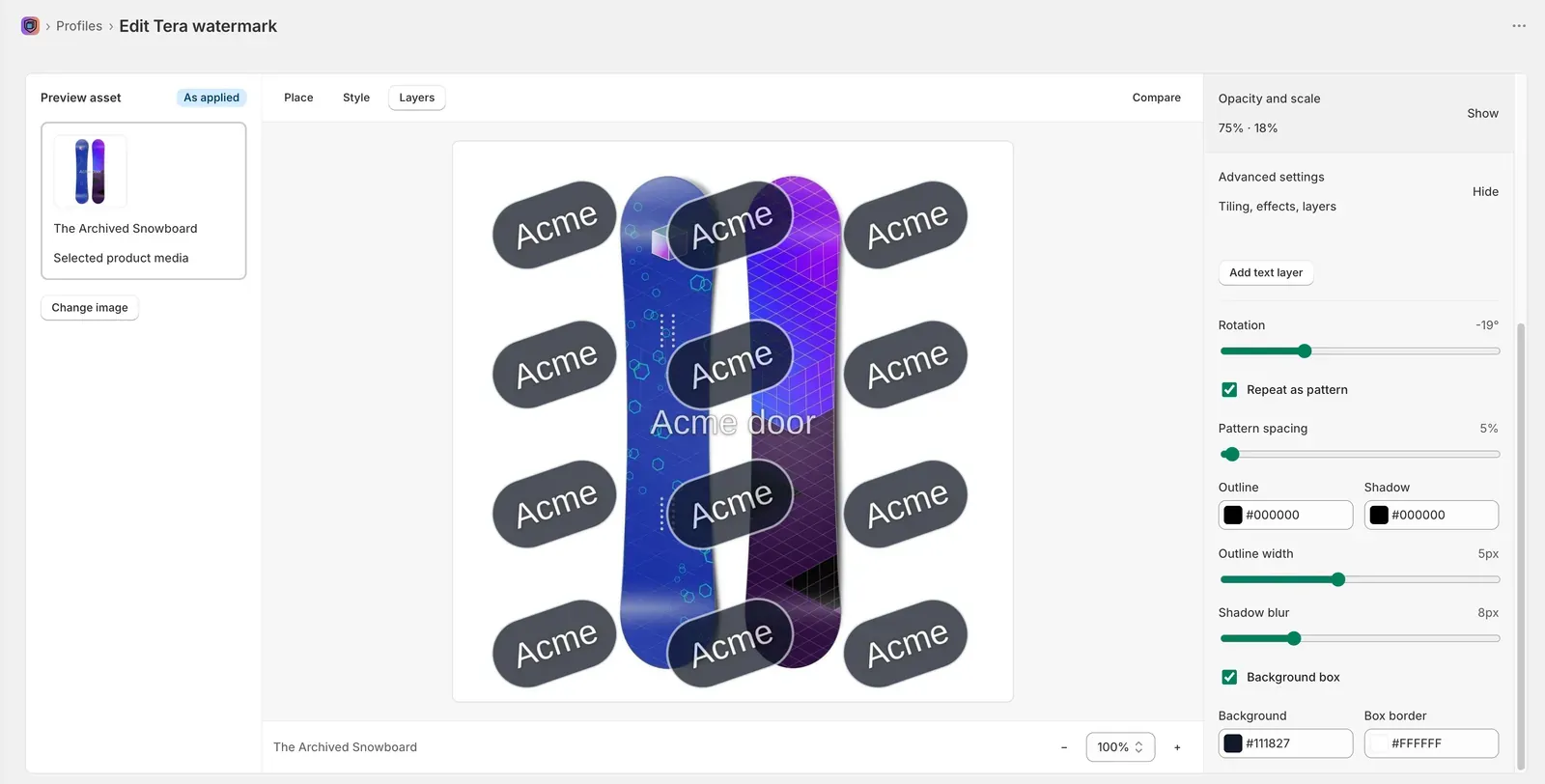
Don't repeat a pixel-identical mark across the catalog
The 2017 research shows that consistency is the weakness: the attack works because the same mark sits the same way on many images. The honest nuance is that, in the researchers' tests, random position shifts and small opacity changes alone did not stop it. Google's research blog put it this way: “simply changing the watermark's position randomly per image does not prevent removing the watermark, nor do small random changes in the watermark's opacity. But we found that introducing random geometric perturbations to the watermark — warping it when embedding it in each image — improves its robustness.”
Use visible text with your name or ©
A store name, domain, or © line makes attribution obvious to anyone who sees the image. It may also matter legally: in the US, knowingly removing copyright management information, which can include an author's name or a © notice, to enable or hide infringement can violate 17 U.S.C. § 1202. This isn't legal advice, and other countries have their own rules.
Accept the trade-off
Each of these steps makes images less clean. So the real decision is which images to mark: keep your main Google Shopping image clean, and put stronger marks on lifestyle shots, original designs, and the photos that get copied most.
Why the main image should stay clean: Google Shopping watermark rules for Shopify.
How RD Watermark's anti-removal variation works (and what it doesn't do)
What it does
On Pro and Unlimited, RD Watermark's anti-removal variation changes your watermark slightly on every image: its position moves by up to 3% of the image's width or height, its angle by up to 5°, its opacity by up to 3 percentage points, and its size by up to 5%. The change is calculated from each original image, so if you restore a photo and apply the watermark again, it gets the same result. Our automated tests check that every shift stays within these limits and that re-running a job produces the same image.
Why it helps
Automated bulk removal works best when the same watermark sits in exactly the same way on many images. In 2017, Google researchers showed that this repetition lets software estimate the watermark and strip it from a whole collection (Dekel et al., CVPR 2017). Variation means no two of your product images carry a pixel-identical mark, so that kind of automated bulk watermark removal is far less effective.
What it doesn't do
It doesn't stop someone from removing the watermark from a single photo with an AI image editor. The same 2017 study also found that random position shifts and small opacity changes alone did not prevent its removal method; subtle warping of the mark helped most, and RD's variation does not warp the mark. Treat it as one layer: combine it with a centered or tiled mark on your most-copied images, storefront protection, and fast takedowns.
How to turn it on
Open a profile in the editor and select the “Anti-removal variation” checkbox. It's on by default for new profiles on Pro and Unlimited. The editor preview shows the base placement; applied images are varied.
Read the release note: SVG logos and anti-removal variation.
Profile settings are explained in the Editor studio guide and in Watermark profiles.
Watermarks are one layer. Here's the rest of the defense.
Storefront deterrents
RD Watermark's storefront protection, included on every plan, can disable right-click, image dragging, and text selection, and make developer-tool shortcuts less convenient. These are casual deterrents only: as our own settings page says, they cannot stop someone who is determined to save or capture an image another way.
Set them up in Storefront protection settings.
Keep your originals and source files
RD Watermark stores each original before it applies a watermark, so you can restore an image or change strategy later, for example moving your most-copied photos to a tiled mark. Restored images don't count against your quota. Stored originals are for undo, not proof of ownership, so also keep your camera RAW files or design source files yourself.
See Restore originals and Data and backups for how long originals are kept.
Find copies
Reverse image search tools such as Google Lens and TinEye help you find where your product photos appear. RD Watermark doesn't monitor the web for copies.
Take them down
If a Shopify store uses your photos, file a copyright notice through Shopify's copyright infringement notice page. Collect the page URLs and your original files first.
Accept what no app can stop
Screenshots can't be blocked by a watermark or a storefront script, and a Shopify store's public /products.json product feed exposes product image URLs to scrapers. That's why the visible watermark, stored originals, and takedowns work together.
Is it illegal to remove a watermark?
Sometimes. In the US, knowingly removing copyright management information, such as an author's name or a © notice, to enable or conceal infringement can violate 17 U.S.C. § 1202. Other countries have their own rules, and the details differ. This isn't legal advice; talk to a lawyer about your situation.
Statute text: 17 U.S. Code § 1202 (Cornell LII).
Frequently asked questions
Can AI remove watermarks from photos?
Yes, often. AI image editors and dedicated removers can erase many visible watermarks from a single photo and fill in the gap, though results can lose detail. Research also shows identical watermarks repeated across many images can be stripped automatically. No watermark is unremovable; good placement just raises the effort.
Is there a watermark AI can't remove?
No watermark is guaranteed to survive. Marks that cross product detail, cover more of the image in a semi-transparent or tiled pattern, and vary from image to image are harder to remove cleanly. Pair them with storefront deterrents, stored originals and takedowns.
Do watermarks still work?
They still deter casual reuse and show where an image came from, which matters because much copying is quick and lazy. They don't stop a determined person with AI tools. Treat a watermark as one layer of protection, not a lock.
Are invisible watermarks better against AI?
Not on their own. Researchers have shown that pixel-level invisible watermarks can be removed with generative AI “regeneration” attacks. Visible marks and invisible marks solve different problems, and neither is unremovable.
What does RD Watermark's anti-removal variation do?
On Pro and Unlimited, it shifts each image's watermark slightly (up to 3% in position, 5° in angle, 3 points in opacity and 5% in size), and the same photo always gets the same shift. Because no two images carry an identical mark, automated bulk watermark removal is far less effective. It doesn't stop someone from editing a single photo with AI.
Is it illegal to remove a watermark?
In the US, knowingly removing copyright management information, such as an author's name or © notice, to enable or conceal infringement can violate 17 U.S.C. § 1202. Laws differ by country. This isn't legal advice; consult a lawyer for your situation.
What should I do if someone uses my photos with the watermark removed?
Collect the page URLs and your original files, then file a copyright notice with the hosting platform. For Shopify stores, use Shopify's copyright infringement notice. Reverse image search tools like Google Lens and TinEye help you find copies.
Make your watermarks harder to strip
Make your watermarks harder to strip. Start free with RD Watermark (100 images, storefront protection included), then try anti-removal variation on Pro with a 14-day free trial.
Install freeCompare plans to see which plan includes anti-removal variation.